 Daniel K
Beeline: from intent to proof

You built an AI feature. But how do you know it’s good enough to give to your users?
Right now you’re answering that on vibes. You tried a handful of inputs, the outputs looked fine. You can’t check everything by hand though, and a machine can’t check it for you, because you never wrote down what “good” means.
The fix isn’t a new tool. It’s a method: write down the definition of “good” as evaluations that run. Let them gate the release, then keep them running in production.
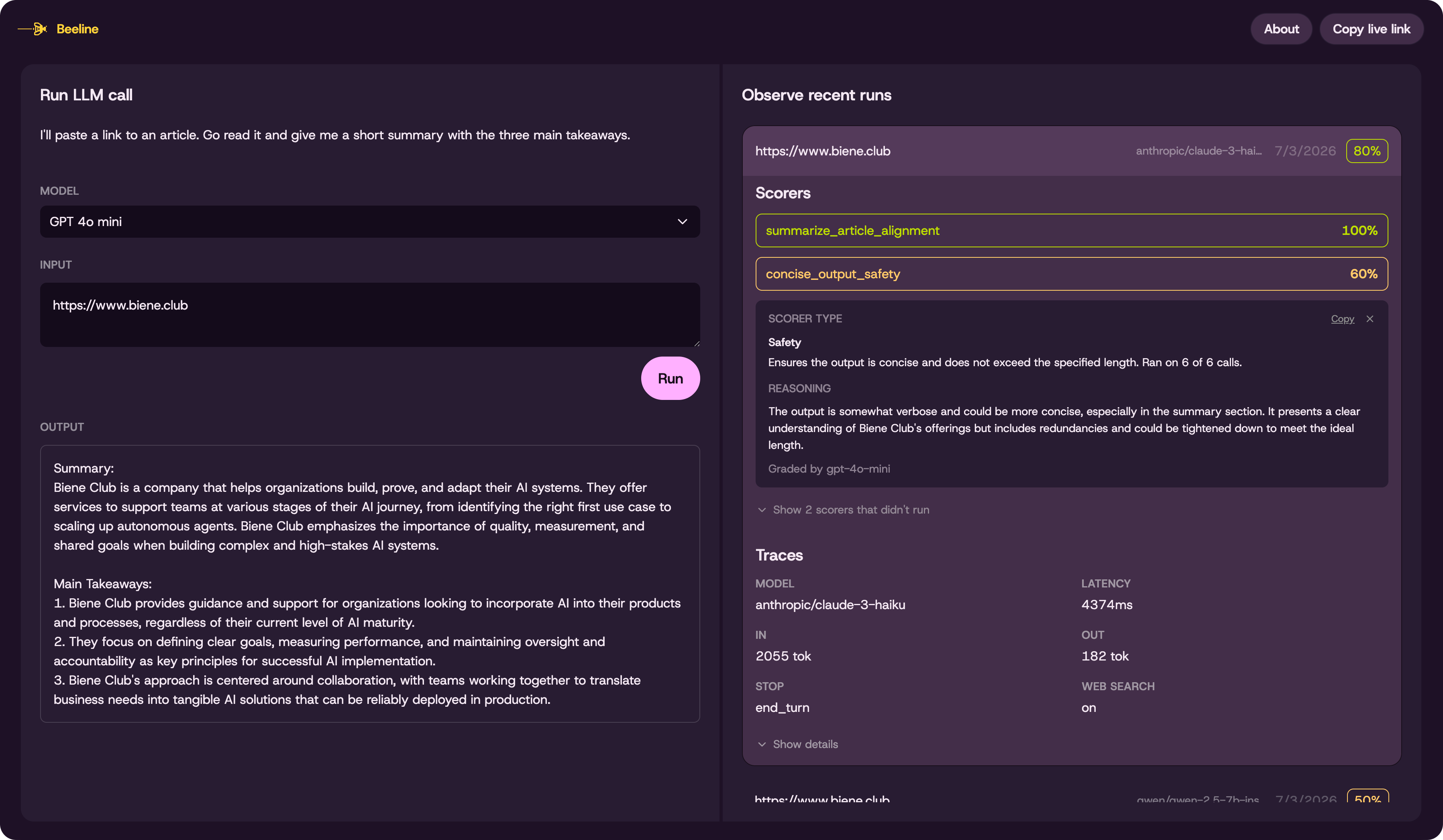
We built Beeline to prove the method works. You describe the feature you want, in a sentence, and its agents do the rest: build it, define “good,” generate a test set, grade the results, rewrite the feature until it passes, and keep score after it ships.
Beeline is a demonstration, not a product. Try it, then steal the process.
What one sentence becomes
Everything hinges on one artifact Beeline creates early: the seed.
Beeline starts by expanding your sentence into use cases, the concrete situations the feature has to handle. A sentence is too vague to test against. A set of use cases isn’t. From those it distills the seed: a structured, testable definition of “good.” Not a paragraph of prose, but discrete criteria grouped by what they check. And every criterion has to earn its place: it has to trace back to something you actually asked for, and it has to be specific enough that two people would grade it the same way.
The seed is what makes everything after it manageable. The dataset and the scorers are both generated from it, so they stay pinned to your use cases instead of drifting off on their own.
Step by step
- Feature. Normally the specification and the code start drifting the day they’re written. Here your intent becomes the working instructions the feature runs on. The prompt is the specification, so there’s nothing to drift from.
- Seed. “Good” is the word everyone nods at and no two people define the same way. The seed forces it into testable criteria, each traceable to something you asked for. In real life, this is where a lot of your judgment goes. Beeline writes it alone, so you can watch the whole flow run end to end.
- Dataset. Everyone means to build a test set but few ever do. Getting the right data is hard, annotating by hand takes time. Beeline generates examples for every use case from the seed, including the edge cases you’d forget, so you grade against the situations that matter instead of the three inputs you happened to try.
- Scorers. Generic evaluation tools can tell you an output isn’t toxic. They can’t tell you it did what you asked. So each criterion in the seed becomes its own scorer: plain code when the rule is crisp, a small judge agent when it’s fuzzy.
- Baseline. Now the pieces meet: the feature runs against every example in the dataset, and the scorers grade the answers. That’s your first real number, and usually a humbling one. The gap now has a size and you can start closing it.
- Loop. Read the scores, rewrite the feature, rerun, keep the best version. The one rule: never edit the seed or the scorers. You don’t move the ruler to hit the mark.
- Production. A wrong LLM answer might come back clean and confident: no error, no alarm. The scorers keep running after launch, grading every live call, and a regression surfaces as an alert instead of a support ticket. Build it for real and you’ll close one more loop: failing calls become new dataset examples.
One intent ran all of it. It framed the problem, defined good, drafted the feature, graded it, gated the release, and now it watches production.
The point
Beeline exists to remove an excuse.
The usual reason teams ship on vibes is that evaluations feel like a second project. There’s a test set to curate, scorers to write, a harness to maintain, and all of it competes with the actual feature for time. Beeline just did the whole second project unattended, from one sentence. If a machine can run the method with nobody driving, your team can run it with someone driving: your judgment applied at the one artifact that deserves it (the seed), and automation doing the rest.
None of this is new. It’s the process on your whiteboard, in the PRD nobody reopens. We just made “good” stop being a paragraph and start being a thing that runs.
Steal it
Really, that’s what it’s for.
But stealing a process still means doing the work: turning your PRDs into runnable scorers, wiring the gates into your pipeline, catching regressions before your users do. That’s what we do with teams at Biene Club. If you’re shipping AI features and want help quantifying “good enough,” let’s talk.